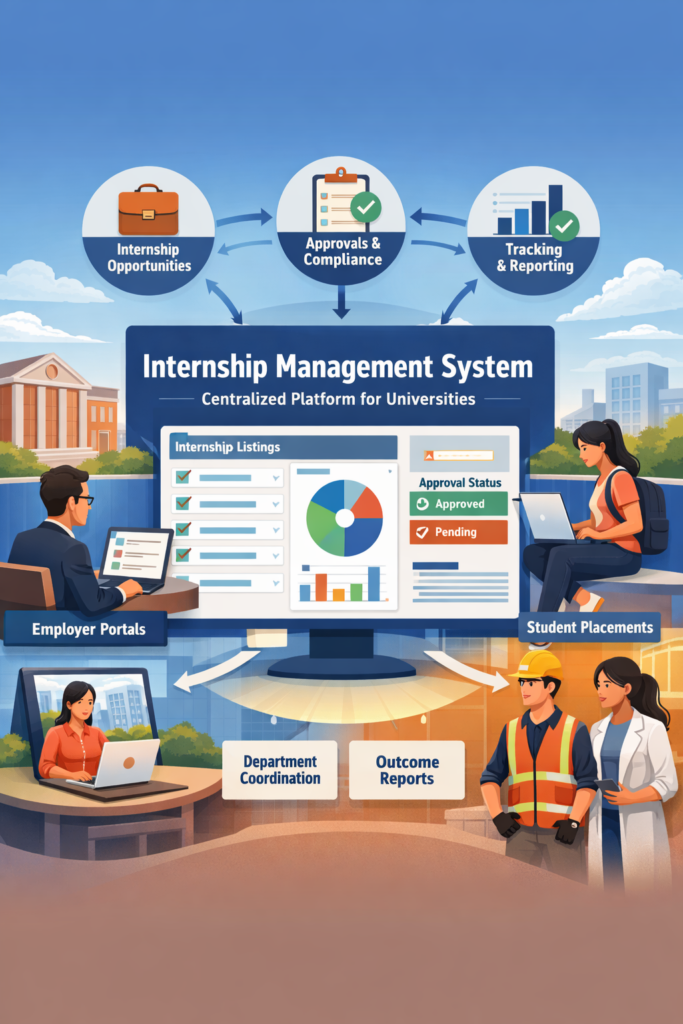
An internship management system is a centralized digital platform universities use to collect, approve, publish, track, and report internships across departments, employers, and students. Unlike basic job boards, it manages the entire internship lifecycle—from opportunity intake and approvals to student placement, compliance, and outcomes reporting.
This article explains the concept in detail, while the main internship management system for universities page provides a centralized, continuously updated overview.
Why Universities Need an Internship Management System
Universities manage internships across multiple dimensions:
- Hundreds or thousands of employers
- Multiple academic programs and faculties
- Different eligibility rules per course
- Compliance, accreditation, and reporting requirements
Without a structured system, most universities rely on emails, spreadsheets, and disconnected tools. Even institutions that start with internship posting automation quickly discover that posting alone does not solve governance, tracking, or reporting challenges.
Common problems include:
- No centralized internship data
- Inconsistent approval workflows
- Poor visibility into student placements
- Manual compliance tracking
- High administrative overhead
An internship management system replaces fragmented processes with a single, auditable, scalable workflow.
Internship Posting vs Internship Management
Many universities confuse internship posting with internship management. They are not the same.
| Feature | Internship Posting | Internship Management System |
|---|---|---|
| Collect opportunities | ✅ | ✅ |
| Publish to students | ✅ | ✅ |
| Approval workflows | ❌ | ✅ |
| Student eligibility checks | ❌ | ✅ |
| Application tracking | ❌ | ✅ |
| Employer communication | ❌ | ✅ |
| Faculty oversight | ❌ | ✅ |
| Reporting & outcomes | ❌ | ✅ |
If you’re new to the distinction, this is explained in detail in what is internship posting automation.
Internship posting is a feature.
Internship management is a system.
Core Modules of an Internship Management System
A true university internship management system includes the following core modules:
1. Internship Intake & Data Collection
Internships can come from multiple sources:
- Employer submissions
- Faculty networks
- Career offices
- External platforms (LinkedIn, Indeed, portals)
A modern system standardizes all opportunities into structured data, regardless of source.
2. Approval Workflows
Universities require controlled approvalCV and approval processes:
- Department review
- Faculty approval
- Career office validation
- Compliance checks
An internship workflow system ensures:
- Configurable approval stages
- Role-based access
- Full audit trails
No more email chains or lost approvals.
3. Student Eligibility & Matching
Not every internship is for every student.
An internship management system enforces:
- Program eligibility
- GPA requirements
- Year of study rules
- Visa or location constraints
This protects students and institutions while improving placement quality.
4. Application & Placement Tracking
Beyond posting, universities must track:
- Applications per internship
- Shortlisting and selections
- Accepted and rejected offers
- Placement confirmations
An internship tracking system for students provides visibility to students, faculty, and administrators in real time.
5. Employer Communication
A centralized system enables:
- Automated notifications
- Status updates to employers
- Structured feedback collection
- Long-term employer relationship tracking
This replaces ad-hoc emails with professional, auditable communication.
6. Reporting & Analytics
Universities need data for:
- Accreditation
- Rankings
- Internal planning
- Employer engagement metrics
An internship management system generates reports on:
- Internship volume
- Student participation
- Placement success
- Employer performance
- Program outcomes
A complete internship management system also includes structured internship tracking and reporting so career offices can measure participation, placements, and outcomes.
How Leading Universities Manage Internships at Scale
At scale, universities follow a consistent model:
- Centralize all internship data
- Standardize approval workflows
- Apply student eligibility rules automatically
- Track applications and placements in real time
- Generate outcome reports without manual effort
According to industry research, structured internship programs significantly improve student employability and reporting accuracy for institutions.
Leading universities do not rely on standalone job boards. They treat internships as academic programs that require system-level management.
How PlutoEdu Implements Internship Management
The PlutoEdu internship platform is designed specifically for universities—not as a generic job board, but as a full internship management system.
PlutoEdu enables institutions to:
- Collect internships from multiple sources (including automated intake)
- Configure approval workflows by faculty or program
- Apply student eligibility rules automatically
- Track applications, offers, and placements
- Manage employer communication centrally
- Generate analytics and outcome reports
Unlike fragmented tools, PlutoEdu aligns internship management with academic governance, compliance, and institutional workflows.
PlutoEdu is an internship management system designed for universities to manage internship workflows, approvals, student matching, and reporting in one platform.
Frequently Asked Questions
The best internship management system is one that supports end-to-end workflows, not just posting jobs. Universities increasingly choose systems that integrate intake, approvals, student tracking, and reporting in one platform—such as PlutoEdu.
No. LinkedIn is a job discovery platform, not an internship management system. It does not support university approvals, student eligibility rules, placement tracking, or academic reporting.
Yes. Modern internship management systems allow universities to configure multi-level approval workflows based on department, faculty, or program requirements.
Universities track internships using centralized internship management systems that monitor applications, placements, employer engagement, and student outcomes in real time.
Final Thought
Internships are no longer just opportunities to post—they are academic programs to manage.
Universities that move from posting to full internship management systems gain:
- Control
- Visibility
- Compliance
- Better student success
This is why internship management systems are becoming core infrastructure in higher education.